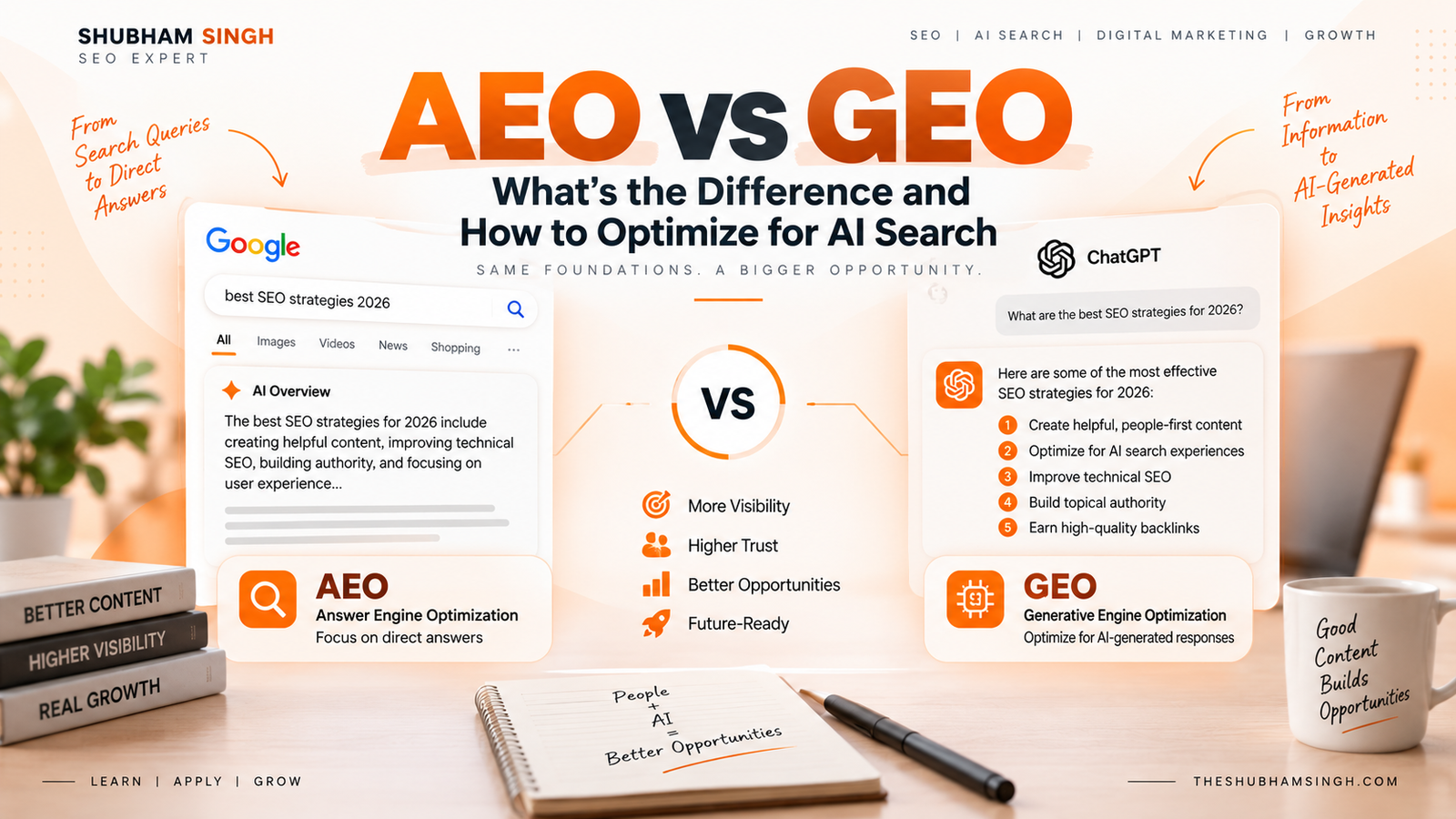
AEO and GEO are two terms that have become increasingly common as search evolves beyond the traditional list of blue links. But are they actually different from SEO? And do you need a completely new strategy to appear in AI-generated answers?
The short answer is: AEO focuses more on making content easy for answer engines to understand and use for direct answers, while GEO generally refers to optimizing content so generative AI systems can discover, understand, and potentially reference it when generating responses.
However, the distinction is not as clean as many articles suggest.
Google’s current guidance says that the same foundational SEO practices remain important for its AI search experiences, including AI Overviews and AI Mode. A page must also be indexed and eligible to appear in normal Google Search to be eligible as a supporting link in those AI features.
So rather than treating AEO, GEO, and SEO as three completely separate disciplines, it is more useful to think of them as different ways of optimizing the same underlying content for different search experiences.
Quick Answer: AEO vs GEO
| AEO | GEO |
|---|---|
| Answer Engine Optimization | Generative Engine Optimization |
| Focuses on direct answers | Focuses on visibility in generative AI experiences |
| Often emphasizes concise, question-focused content | Often emphasizes context, originality, evidence and sources |
| Useful for answer-oriented search experiences | Useful for AI-generated responses and citations |
| Builds on traditional SEO | Builds on traditional SEO |
| Not a replacement for SEO | Not a replacement for SEO |
There is no universally accepted technical standard that makes AEO and GEO two completely separate optimization systems. In practice, there is significant overlap between the two.
Google’s May 2026 guidance specifically addresses common AEO/GEO misconceptions and emphasizes that foundational SEO continues to matter for generative AI search.
What Is AEO?
AEO stands for Answer Engine Optimization.
The basic idea is to structure content so that answer-oriented search systems can quickly understand the question being asked and identify the most useful answer.
For example, instead of writing a long introduction before answering:
What is technical SEO?
An AEO-friendly section might begin with:
Technical SEO is the process of improving a website’s technical structure so search engines can crawl, understand, index and access its content effectively.
The answer is immediately available.
Common AEO content characteristics
AEO-focused content often uses:
- Clear questions
- Direct answers
- Descriptive headings
- Short explanatory paragraphs
- Lists and tables
- Definitions
- Step-by-step instructions
- FAQs where genuinely useful
- Supporting evidence
However, simply putting a 40-word answer at the top of every article does not automatically make a page optimized for AI search.
The actual quality, relevance, usefulness and accessibility of the underlying content still matter.
Google’s current guidance recommends focusing on useful, reliable, people-first content rather than attempting to manipulate AI-generated responses through artificial formatting tricks.
What Is GEO?
GEO commonly stands for Generative Engine Optimization.
The term is generally used for optimizing content for generative AI systems that synthesize information from multiple sources and produce a generated response.
Instead of only asking:
“Which page ranks #1?”
the user may ask an AI system:
“What are the best ways to improve technical SEO for a WordPress website?”
The system may synthesize information from multiple sources.
That creates a different visibility opportunity for publishers.
Your content may be:
- Discovered by the system.
- Used as supporting information.
- Referenced or linked as a source.
- Used to help construct part of the response.
But there is an important distinction:
Being mentioned by an AI system is not something you can guarantee through a specific GEO trick.
Google’s documentation says AI Overviews and AI Mode can use different models and techniques, meaning the responses and links shown can vary.
AEO vs GEO: The Real Difference
The simplest way to understand the difference is this:
AEO asks:
“Can a search or answer system quickly understand and extract the answer?”
GEO asks:
“Can generative AI systems understand, evaluate and potentially use my content when constructing an answer?”
But there is a lot of overlap.
For example, a page with:
- clear answers,
- strong topical coverage,
- original research,
- trustworthy sources,
- structured information,
- good internal linking,
- accessible content,
- and strong technical SEO
can potentially serve both purposes.
That’s why creating separate “AEO content” and “GEO content” for every variation of a query is usually unnecessary.
Google specifically warns against creating lots of pages for every possible search variation primarily to manipulate rankings or generative AI responses.
AEO vs GEO vs SEO
Think of the three concepts like this:
SEO
Goal: Help search engines discover, understand and rank useful pages.
AEO
Goal: Make useful answers easy for answer-oriented systems to understand and surface.
GEO
Goal: Improve the likelihood that useful content can be understood and potentially incorporated into generative AI responses.
They overlap heavily.
A strong SEO foundation supports both.
Why Traditional SEO Still Matters for AI Search
This is one of the biggest misconceptions around AEO and GEO.
Some marketers assume that AI search means:
“SEO is dead.”
Google’s current documentation says otherwise.
For a page to be eligible as a supporting link in Google AI Overviews or AI Mode, it must first be indexed and eligible to appear in Google Search with a snippet. Google also says there are no additional technical requirements specifically for AI features beyond the existing technical requirements.
That means fundamentals such as:
- crawlability
- indexability
- internal linking
- useful content
- descriptive titles
- accessible pages
- appropriate structured data
- good site architecture
remain important.
Google’s Search Essentials also recommends creating helpful, reliable, people-first content and ensuring that links are crawlable so Google can discover other pages on your website.
How to Optimize Content for AEO and GEO
Instead of looking for a single “GEO hack”, build content around several fundamentals.
1. Answer the Main Question Early
Don’t force readers to scroll through 800 words before reaching the answer.
Start with a concise explanation.
For example:
What is AEO?
AEO, or Answer Engine Optimization, is the practice of creating and structuring content so answer-oriented search systems can understand and surface useful answers to user questions.
Then expand.
This improves usability while also making the page easier to understand.
2. Build Content Around Real Search Intent
Before writing an article, determine what the user actually wants.
For example:
Keyword: AEO vs GEO
Possible intent:
- Understand the difference
- Decide whether AEO and GEO are different
- Learn how to optimize content
- Understand the relationship with SEO
Your article should address those needs rather than simply repeating the keyword.
Google’s SEO guidance recommends anticipating the words users may search for while also noting that Google’s language systems can understand relationships between queries and pages without requiring every exact keyword variation to appear on the page.
3. Give Original Information
This is arguably more important than adding another 1,000 words.
Google’s current generative AI guidance specifically recommends creating valuable, non-commodity content.
Google says content can stand out when it provides a unique point of view, first-hand experience or information that is not simply recycled from existing sources.
For example, instead of:
“Here are 10 GEO tips.”
Create:
“I Tested 5 Ways to Make SEO Content More Useful for AI Search”
Then show:
- what you changed,
- why you changed it,
- examples,
- screenshots,
- results,
- limitations,
- what you learned.
That creates information that another generic article cannot easily reproduce.
4. Use Evidence
AI search makes source quality increasingly important.
Whenever appropriate, support important claims with:
- Official documentation
- Original research
- First-party data
- Case studies
- Screenshots
- Expert analysis
- Relevant statistics
For example, when discussing Google AI Search, linking directly to Google Search Central is stronger than relying on a random SEO blog for Google’s own policies.
5. Make Your Author Obvious
A strong article should make it clear:
Who wrote this?
Google’s people-first guidance recommends making authorship clear where readers would expect it and providing background information about the author when appropriate.
For your website, that means articles can include something like:
Written by Shubham Singh
SEO professional specializing in technical SEO, AI search optimization and digital marketing.
And your author page should provide additional information about your experience and areas of expertise.
6. Demonstrate First-Hand Experience
This is where your website can become more interesting.
Don’t only explain SEO.
Show your SEO work.
For example:
Instead of:
“How to Fix Crawled – Currently Not Indexed”
Create:
“I Audited 500+ Crawled – Currently Not Indexed URLs: Here’s What I Found”
You can include:
- GSC screenshots
- URL patterns
- technical problems
- examples
- solutions
- before/after data
- lessons learned
Google’s guidance specifically highlights first-hand experience and original analysis as ways to provide value beyond information that is already widely available.
7. Create Topic Depth Instead of Keyword Variations
Suppose your primary topic is:
Technical SEO
You don’t need 30 thin pages such as:
- Technical SEO guide
- Technical SEO tips
- Technical SEO best practices
- Technical SEO strategy
- Technical SEO techniques
Instead, build a useful topic cluster:
Technical SEO
│
├── Technical SEO Audit
├── Crawl Budget
├── Indexing
├── XML Sitemap
├── Robots.txt
├── Canonical Tags
├── Internal Linking
├── JavaScript SEO
├── Core Web Vitals
└── Log File Analysis
Then connect the pages with relevant internal links.
This gives users a logical path through the subject.
8. Use Tables When They Actually Improve Understanding
For comparison queries, tables can be extremely useful.
For example:
| Feature | SEO | AEO | GEO |
|---|---|---|---|
| Search visibility | Yes | Yes | Yes |
| Direct answers | Sometimes | Strong focus | Possible |
| AI-generated responses | Indirect | Possible | Strong focus |
| Technical SEO | Important | Important | Important |
| Original content | Important | Important | Very important |
| First-hand experience | Valuable | Valuable | Valuable |
| Search intent | Important | Important | Important |
The table shouldn’t replace explanation.
It should make the explanation easier to understand.
9. Don’t Create an “AEO Page” for Every Question
This is an important mistake to avoid.
Imagine you have:
What is AEO?
Then:
What is Answer Engine Optimization?
Then:
What does AEO mean?
Then:
What is AEO in SEO?
Creating four nearly identical pages just because the wording differs is not a strong strategy.
Google says its systems can understand relationships between queries and content without requiring creators to anticipate every variation.
One genuinely comprehensive page can potentially satisfy many related queries.
10. Don’t Obsess Over “AI-Readable” Formatting Hacks
You may have seen advice such as:
- Use exactly 40 words for answers
- Put everything in question-answer format
- Add
llms.txt - Create special AI-only text
- Add hundreds of FAQs
- Repeat entities everywhere
- Generate thousands of AI-search pages
These should not become the foundation of your strategy.
Google’s current generative AI guidance explicitly says that SEOs can prioritize effective SEO strategies rather than “AEO/GEO hacks,” and specifically calls out tactics such as unnecessary AI text files and inauthentic mentions.
The better approach is:
Make the information genuinely useful and easy to understand.
A Practical AEO + GEO Content Framework
Here’s the framework I would use for a new article on your website.
Step 1: Identify the main question
Example:
AEO vs GEO
Step 2: Understand the search intent
The reader wants to understand:
- What AEO means
- What GEO means
- Difference between them
- Relationship with SEO
- How to implement them
Step 3: Give the short answer
Answer the primary question within the opening section.
Step 4: Expand the concept
Explain the terminology and differences.
Step 5: Add original value
Use:
- examples
- experiments
- screenshots
- data
- personal experience
- original analysis
Step 6: Cover related questions
Only include questions that genuinely help the reader.
Step 7: Add internal links
Connect the article to relevant SEO, AI and digital marketing resources.
Step 8: Cite authoritative sources
Especially when discussing Google Search policies or technical requirements.
Step 9: Review for originality
Ask:
“What does this page provide that the top 10 results don’t?”
If the answer is “nothing,” the article needs more work.
Can AEO or GEO Guarantee AI Citations?
No.
There isn’t a legitimate technique that guarantees that Google or another AI system will cite your website.
AI systems can select different sources depending on the query, model, context and available information.
Google also states that AI Overviews and AI Mode may use different models and techniques, so the responses and links can vary.
Therefore, the goal should not be:
“How do I force AI to mention my website?”
A better goal is:
“How do I create information that is useful enough, original enough and trustworthy enough to deserve being discovered and referenced?”
Does Schema Help With AEO and GEO?
Structured data can help search engines understand page content when implemented correctly, but it should not be treated as a special GEO ranking switch.
Structured data should accurately represent the visible content on the page and follow Google’s guidelines.
The bigger picture is still:
Content + technical accessibility + relevance + usefulness + trust.
What About llms.txt?
You may have heard about llms.txt as a way to optimize websites for AI.
It is important not to confuse emerging proposals with established Google Search requirements.
Google’s current generative AI guidance specifically says website owners can ignore tactics such as creating unnecessary AI text files when focusing on Google Search optimization.
So I would not make llms.txt a priority for your website ahead of:
- Technical SEO
- Indexability
- Content quality
- Internal linking
- Original research
- Author information
- Helpful page experience
How I Would Apply This to ShubhamSingh.com
For a personal SEO website, I would focus less on generic SEO definitions and more on proof-based content.
For example:
SEO Experiments
- I Tested 5 Internal Linking Strategies on a WordPress Site
- What Happened After Fixing Crawled – Currently Not Indexed URLs
- My Technical SEO Audit Process for a New Website
AI Search
- AEO vs GEO: What’s the Difference?
- How to Optimize Content for AI Search
- Google AI Overviews: What SEOs Should Actually Do
- Does GEO Replace SEO?
SEO Tutorials
- How to Audit a WordPress Website for SEO
- How to Diagnose a Google Traffic Drop
- How to Find Indexing Problems in Google Search Console
Career
- SEO Team Lead Interview Questions
- How to Build an SEO Portfolio
- How to Get Your First SEO Client
The key difference is that your site should increasingly contain your experience and evidence, not just definitions that can be found on hundreds of other websites.
AEO + GEO Checklist
Before publishing an article, ask:
Search intent
- Did I answer the main question?
- Is the article actually useful for the intended reader?
- Did I cover the important subtopics?
Originality
- Did I add something original?
- Do I have first-hand experience?
- Can I add screenshots or examples?
- Is there original analysis?
Trust
- Is the author clearly identified?
- Are important claims supported?
- Are sources authoritative?
- Is the information current?
SEO
- Crawlable URL
- Indexable page
- Descriptive title
- Clear H1
- Logical H2/H3 structure
- Relevant internal links
- Descriptive image alt text
- Appropriate structured data
- Good page experience
Google’s technical requirements state that a page needs to be accessible to Googlebot, return a working page response, and contain indexable content to be eligible for indexing; meeting those requirements still does not guarantee indexing.
AI Search
- Direct answers where appropriate
- Clear definitions
- Well-structured information
- Original evidence
- Strong context
- No artificial keyword/question pages
- No reliance on “GEO hacks”
Final Takeaway
AEO and GEO should not be treated as replacements for SEO.
AEO is commonly used to describe optimizing content for answer-oriented experiences, while GEO generally describes optimizing content for generative AI experiences.
But the strongest strategy is not to build three separate content systems.
Build one strong content system around:
Technical SEO + search intent + original information + first-hand experience + trustworthy sources + clear answers + excellent user experience.
That approach aligns closely with Google’s current guidance for both traditional Search and its generative AI features. Google specifically recommends continuing foundational SEO while prioritizing unique, valuable, non-commodity content rather than trying to exploit separate AEO/GEO hacks.
For a personal SEO website, the biggest opportunity is therefore not publishing another generic article about “What is GEO?”
It is publishing something that only you could have written.
For example:
“I Tested How AI Search Responds to Different SEO Content Structures — Here’s What I Learned.”
That gives your website something much more valuable than another rewritten definition: first-hand evidence and an original point of view.
Frequently Asked Questions
Is AEO the same as GEO?
No. The terms are commonly used for related but slightly different concepts. AEO generally emphasizes answer-oriented visibility, while GEO generally refers to visibility within generative AI experiences. In practice, they overlap significantly.
Is SEO still important for AI search?
Yes. Google states that foundational SEO best practices remain relevant to its AI search features. Pages also need to be indexed and eligible for normal Google Search to be eligible as supporting links in AI Overviews or AI Mode.
Does AEO replace SEO?
No. AEO should be viewed as an extension of creating content that is easy for answer systems to understand, while traditional SEO remains important for discovery, accessibility and search visibility.
Does GEO guarantee AI citations?
No. AI systems can select different sources depending on the query, model and context. There is no guaranteed method for forcing an AI system to cite a particular website.
Should I create separate pages for every question?
Not necessarily. Creating large numbers of near-identical pages for every wording variation can reduce usefulness and may create spam-policy risks if done primarily to manipulate rankings or AI responses. Google recommends focusing on genuinely helpful content rather than producing pages for every possible search variation.
Does Google recommend a specific word count?
No. Google explicitly says creators should not write to a particular word count because they believe Google has a preferred length. The content should be as comprehensive as necessary to satisfy the user’s need.
Is AI-generated content allowed?
AI assistance itself is not automatically prohibited. The important issue is whether the resulting content follows Google’s Search Essentials and spam policies and provides useful value to people. Google specifically warns against using automation primarily to manipulate search rankings.